Saturday, August 23, 2008


Friday, August 22, 2008
THE PONDO NG PINOY MOVEMENT SOCIAL TRANSFORMATION THROUGH INTEGRAL EVANGELIZATION
The Second Plenary Council of the Philippines (PCP II) presents a vision for the Filipino nation.
We shall have to create a free nation:
where human dignity and solidarity
are respected and promoted;
where moral principles prevail in socio-economic
life and structures;
where justice, love, and solidarity are the inner
driving forces of the development.
We shall have to built a sovereign nation:
where every tribe and faith are respected;
where diverse tongues and traditions work
together for the good of all;
where membership is a call
to participation and involvement
and leadership a summons to generous service.
Ours will have to be a people:
in harmony with one another
through unity in diversity;
in harmony with creation,
and in harmony with God.
Ours shall be a civilization of life and love.
Pondo ng Pinoy is a movement to develop a Filipino culture rooted more deeply in love of God and neighbor, especially the poor, through little but repeated acts of compassion, solidarity and sharing. Pondo ng Pinoy is also a community foundation born out of the daily contributions of concerned people that will support programs benefiting the poor. As a movement and as a community foundation, Pondo ng Pinoy calls on all Filipinos to care for others so as to attain fullness of life in God.
Pondo ng Pinoy (PnP) was launched on June 11-12, 2004. Its agenda is Integral Evangelization, bringing the Good News of salvation and liberation to the totality of life, no different from that of PCP II. Its objective is to penetrate all the strata of human life with the vision of the Kingdom of God. The formula is to make effective or operational the love of Jesus in our daily lives. When actions promote moral values, they become good operative habits that are considered virtues. Virtues build character, and character produces morally upright action. PnP aims at reversing society’s neglect of the poor by bringing them to the center of the consciousness of Filipinos and attending to their needs especially in the areas of livelihood, housing, education and health care.
The education component of PnP is its distinctive and hopefully, best feature. PnP promotes the formative dimension of social transformation. It is catechetical in nature – direct proclamation of the gospel values of Jesus Christ. The sharing of twenty-five centavos (0.25) becomes the integrating moment in the catechetical framework. It is the concrete expression of love, of a life lived for others. Thus education is coupled with action on behalf of neighbors.
PnP education focuses primarily on the evangelization and empowerment of the family, without neglecting other sectors and institutions. The family is meant by God to be the first school of discipleship where the parents are the first catechists of their children, and where all the members mutually evangelize each other. (PCP II 576) The family is where concern for neighbor, honesty and the sense of justice, truthfulness and caring for creation should be inculcated.
PnP is a way of bringing to people the social doctrine of the Church as a means for integral evangelization. The Church’s social doctrine presents principles of reflection, criteria of judgment and directives for action oriented towards moral conduct. We need to proclaim these components, “whether convenient or inconvenient – correcting, reproving, appealing – constantly teaching and never losing patience’ (II Tim 4:2).” (PCP II, 292)
The basic tenets of the Church’s Social doctrine are:
1. Integral Development – Human Dignity & Solidarity
2. Respect for Human Life
3. The Social Nature of the Human Person and Human Equality
4. The Universal Purpose of Earthy Goods and Private Property
5. Social Justice and Love (Solidarity and Subsidiarity)
6. Association and Participation (Family Life)
7. Preferential Protection of the Poor and Vulnerable
8. Peace and Active Non-violence
9. The Value of Human work
10. Integrity of Creation
11. People Empowerment
12. The Common Good Inseparable from the Good of Persons
The sectors that PnP education and catechesis want to reach are:
1. Families
2. Educational Institutions –
• Public Schools through the Diocese/Parish Catechists
• Catholic Schools through the Religious Education Department and Campus Ministry
• Non-Sectarian Schools through the Archdiocesan or Diocesan Campus Ministry of the Ministry for Youth Affairs
3. Parishes and Basic Ecclesial Communities (BECs)
4. Movements of Renewal: the Cursillos de Cristianidad, the Catholic Charismatic Renewal, Lay Covenant Communities, the Neo-catechumenal Way, the Christian Family Movement, Marriage Encounter, Focolare, the Movement for a Better World, the Parish Renewal Experience (PREX), etc.
5. Catholic Hospitals and Community-Based Health Care Workers
6. Practitioners of the Media of Social Communication
7. Corporate and Business Communities
8. Tribal Filipinos
9. Peasants
10. Urban Poor
11. Fisherfolk
12. The Disabled
13. Prisoners and other Special Sectors
14. Overseas Filipino Workers (OFWs)
The objectives of PnP education and catechesis are:
1. To cultivate a spirituality of social transformation through the formation of social conscience;
2. To build up a participatory church and caring community through a life long process of learning and self-giving to the poor; and
3. To imbue the culture with the values of the gospel in the spirit of ecumenism and inter-religious dialogue.
PnP AS A COMMUNITY FOUNDATION
Although initiated by the Church, Pondo ng Pinoy (PnP) is not a Church foundation but a community foundation. The community owns the fund it generates. PnP intends to help needy Filipinos, within and beyond the Catholic Church.
1. The Church is the initiator, promoter and steward of PnP. The Church took the first steps in launching the movement and the foundation. The Church undertakes the education of people so as to promote the vision of PnP. The Church takes care of the fund and monitors its disbursement. The Church maintains the focus on the spiritual and cultural values of the movement so as to avoid reducing PnP to raising money only.
2. Although PnP is a community foundation it does not follow that any person can just intrude in the dispensation of the fund. As an alternative to bad governance, PnP should exercise care in the handling and disbursement of the donated money. We learn from history how some groups with political or ideological agenda and narrow interests have manipulated the use of community funds. The renewed culture of compassion and integrity that the PnP movement wants to generate should be mirrored in the operations of the community foundation.
3. The Church is the primary steward of the foundation. For the purpose of ensuring the proper handling and disposal of the fund, the foundation will be headed by a Board of Trustees composed of distinguished lay leaders, religious, priests and bishops. The lay leaders or pastoral workers who will be part of PnP leadership may come from any economic stratum of society, provided they share the orientation of the Church, are committed to and involved in community service, and have shown competence in leadership and management. The empowerment of the poor communities will happen primarily in the management of the actual projects in their midst, of which they are both investors and beneficiaries. The involvement of laypeople, NGO’s, PO’s and other organized groups with a track record of genuine service to the poor is a necessary component of the operations of PnP.
THE ORGANIZATION OF PnP
Since the establishment of the community foundation was the initiative of bishops, the dioceses and parishes will provide the basic framework for the organization of PnP. The spirit of communion and solidarity should be reflected in the organizational structure of PnP. Both as a movement and a community foundation, PnP has a Central Office with dioceses and parishes as local implementing arms. But while PnP uses diocesan and parish offices, PnP is an entity distinct from the Dioceses and Parishes. Hence, PnP will not supplant, but support and enhance diocesan or parochial initiatives or activities, especially those directed towards the well being of the poor.
1. The Priority Areas of Concern of PnP in relation to Diocesan/Parochial Pastoral Plans
a. Since PCP-II, the Church in the Philippines has been pursuing a mission of renewed integral evangelization. PnP can be a tool for evangelization, especially of the “un-churched” who make up 85% of the Catholic population. PnP could serve as initial evangelization and entry point for their participation in the life and mission of the Church. It could also be a venue for ecumenical and inter-religious programs of
dioceses and parishes. Some sectors and establishments that could be targeted are the following: offices, factories, commercial establishments, markets, government institutions, schools, transport sectors, and informal sectors.
b. The PnP orientation should be creatively integrated and adapted to the components of diocesan/parochial pastoral plans, e.g. family life, BEC’s, advocacy, catechesis, ministry to sectors, youth, education, ecumenical and inter-religious dialogue, etc. Local realities must be considered in the adaptation.
c. Priority areas of concern of PnP, i.e. livelihood, housing, education and health care, are the same priority areas of any social action desk or BEC. The evangelization, education, formation and catechetical ministries can integrate elements of PnP wherever possible. Ultimately the various diocesan/parochial groups and structures should work together in promoting the various components of PnP.
d. Fund generating activities and traditional sources of funds of the diocese/parish, especially the newly established ones, will be respected by PnP. If the donors prefer to give directly to diocesan/parochial projects, they are free to do so, while being encouraged to undergo the evangelization program of PnP.
2. Central and Local Organization and Operation
The Diocesan PnP Desk
a. Participating dioceses or apostolic vicariates will set up their own PnP Desk headed by the Bishop, with the Diocesan Chancery as its base. Serving as an arm of the community foundation, the Diocesan/Vicariate PnP Desk will operate within the existing diocesan structure, e.g. the Social Action Center. The diocesan office within which the PnP Desk operates shall assume the operational expenses of the Desk. The PnP Desk will rely, therefore, on the staff of the diocese and parishes, parish pastoral councils, church organizations and ministries for human resource. Consistent with the culture of sharing that PnP is cultivating, volunteerism is to be encouraged in the running of the PnP Desk.
Where possible and needed, the PnP Desk may set up local committees that correspond to the subcommittees of the Central Program Committee (Organizational Development, Education, Promotion, and Projects Review and Screening). Parishes, schools and other participating local bodies must designate a person who will serve as a link to the PnP Desk.
b. The Bishop will appoint a PnP Diocesan/Vicariate Coordinator from among the lay, religious or clergy. The Coordinator oversees the operations of the PnP and the various subcommittees, links with the participating parishes and institutions in the diocese/vicariate and the central office, monitors the collection, submission and distribution of money, keeps records, inspects projects funded by the PnP and regularly reports to the Bishop on the state of the PnP in the diocese/vicariate. The Coordinator must be of good moral standing in the community, must have a record of community involvement, and must be skilled in financial management.
c. The PnP Central Office will prepare the initial programs of PnP. The Diocesan PnP Desk can adapt the materials and programs to fit their local contexts. The central office also acts as the monitoring body of the various initiatives from the dioceses/vicariates and of the total inflow of resources.
Education
The basic operational need is to promote and deepen the understanding of people on the vision, the spiritual, theological and social dimensions of PnP and the principles and values it aims to uphold.
a. There should be a local education committee to be composed of diocesan/vicariate catechetical coordinators and heads of religious education of catholic schools and other groups that the dioceses/vicariates would designate. It shall be responsible for the writing of modules for the sectors and the dissemination of materials through the speakers’ bureau.
b. Formation for capacity building will be offered to people who will help implement the vision and programs of PnP, especially those in the Diocesan/Vicariate PnP Desk, speakers and training facilitators. Skills and technical training will be provided.
Promotion
a. Brochures will be circulated to orient people on PnP. A primer will go with the brochure to further clarify the vision and mechanics of PnP as a movement and a community foundation. It will include guidelines for conducting launchings of PnP.
b. The Central Office of PnP will provide the initial brochures and promotional materials. The PnP Desks will assume responsibility for them when their fund resource begins to stabilize.
c. Promotional activities will be programmed according to the stages of implementation. Since education is the prerequisite for a genuine participation in the giving and collection of the “crumbs”, promotional materials will focus first on education regarding the vision of PnP.
d. Plug-ins will be solicited from Radio Veritas and local radio stations run by the church. Other available radio stations whose owners and/or top management share the vision of PnP will be requested to regularly feature PnP, especially through jingles and ad lines. These will make PnP a household byword. Talk shows and news clips over the radio and television can help promote PnP. Tri-media exposure will optimize awareness.
Gathering of the “Crumbs”
a. All parishes, schools, universities, organizations, etc. are enjoined to deposit their contributions to PnP depository banks and furnish the PnP Central Office and their respective Diocesan Chancery with a copy of the deposit slip. Contributions may also be forwarded to the PnP Desk in the Chancery; the PnP Desk will in turn forward the funds to the PnP Central Office through designated banks. Through the centralization of funds we hope PnP will have a stronger impact on the national scene. It is also a way of giving poorer dioceses access to funds that they could not raise by themselves.
b. The Coordinator will keep separate records of the contributions of parishes, schools and organizations or institutions and submit a quarterly report on the participation of these various conduits in his/her Diocese. The Central Office will track the contributions of the dioceses to the central fund.
Distribution of the “Crumbs”
a. Non-profit organizations, like the diocesan and parochial social action offices, NGO’s, religious organizations and other sectors, can submit to the PnP Desk project proposals for programs that will directly benefit the poor. The proponents must meet the criteria set by the Central Projects Review and Screening Committee to qualify for consideration. The PnP Desk will constitute a Diocesan Review and Screening Committee to recommend to the Coordinator and the Bishop which projects merit support. Projects not exceeding three hundred thousand pesos (P300,000.00) need only the approval of the PnP Desk while those beyond the said amount need to be submitted to the Central Projects Review and Screening Committee for final approval.
b. Projects must have the approval of the bishop to qualify for funding. Projects needing only Diocesan approval must have the endorsement of the parish priest where the project will be carried out. Projects to be submitted to the Central Projects Review and Screening Committee for final approval must be endorsed by the bishop of the place where the project will be implemented. The Diocesan and Central Projects Review and Screening committees will issue a list of priority programs that PnP will support as well as the guidelines in processing and approving proposals.
c. Funds for diocese-approved projects will be released to the PnP Desk. For this purpose, the PnP Desk will open a bank account to which the Central Office could remit funds directly. The PnP Desk must have a separate book of accounts. For projects approved by the Central Projects Review and Screening Committee, funds will be released to the project proponents through the PnP Desk. Memoranda of agreement will be signed between the project proponents and the PnP Desk or the Central Office.
d. The Coordinator is responsible for monitoring supported projects and reporting to the Central Projects Review and Screening Committee. All projects shall be subject to periodic and annual external financial, compliance, management and project-end social audit. The community foundation can withdraw or terminate its assistance at any time should the project proponent, after due process, is proven to have violated the terms and conditions of the assistance and to have failed to act on monitoring and audit findings.
Hapagasa Feeding Program (June-July 2006)
Antipolo P 17,050 920 children
Cubao 176,830 546 children
Daet 44,000
Kalookan 169,675 315 children
Manila 990,422 2,240 children
Malolos 10,710 84 children
Novaliches 285,800 860 children
San Pablo 270,770 563 children
Project Updates
Assistance and Support for Daycare Children and Empowerment of Women in
Highly Depressed Urban Poor Communities
Archdiocese of
Proponent: Akap Bata sa mga Guro-Kalinga, Inc.
Sharlyn delos
Akap Bata’s support program for Day Care children targetted assistance for 185 children in four centers. At the end of the project, they reported assisting 76% or 141 children. The children’s centers are located in Tondo,
Pondo ng Pinoy Lending Program
Diocese of Daet
Proponent: Diocesan Multi-Purpose Cooperative
Manay Remy, a fish vendor in the Public Market of Daet, recounted in a recent project visit: “Minsan paiba iba ang dating ng kita (income) ko sa pagtitinda ng isda, Minsan P300, minsan 200 lang, pag medyo siniswerte may P500 sa isang araw, pero ang mahalaga, nakakabayad ako ng regular sa utang ko sa kooperatiba”. Sa ngayon, nakatatlong beses na akong mangutang, dahil sa pautang na ito, tuloy tuloy ang aking pagtitinda.
The microfinance program of MSSD allows small entrepreneurs easy access to credit facilities with features not offered by the local usurers. The project initially started with four beneficiaries, to date the cooperative has 70 members with over P60,000 in savings deposits and share capital and a loan portfolio of over P400,000 in regular and salary loans. Businesses supported inlcude dry goods trading, sari-sari store operations, calamansi and vegetable trading, and fish vending.
Augmentation of the Ecological Waste Management Livelihood for the Scavenger’s Organization
Archdiocese of
Proponent: Archdiocese of
Under the Ecology Desk is the Kabalikasang Samahan Inc., an organization that helps scavengers in their segregation, collection and marketing of wastes. The main goal of this project is to be able to help the scavengers in forming their own business as a group in five years time. The workers are given a daily allowance of P175 fo rthe work that they do. Pondo ng Pinoy funded the construction of the composting facility. they were able to produce a steel structure for storage and green house. Mang Danilo Estinor, president of the organization, says that this project has helped him in his livelihood, the ecology desk is a safer environment that the dump sites and they even earn more money. Aling Anita, who is in charge of the organization’s marketing department said that the projects allows them to store and properly segregate the waste until it is enough to sell to the recycling plants who pay a bigger amount compared to the junk shops. The greenhouse facility also serves as the demonstration area for segregation and composting education for the public andparochial schools under the diocese.
Projects Approved by Local Bishops
| | PONDO NG PINOY COMMUNITY FOUNDATION | |
| | | |
| | Project Submitted and Approved during the period May 1 - | |
| DIOCESES/PARISHES | PROPOSAL/ PROJECT TITLE | APPROVED AMOUNT |
| DIOCESE OF IMUS MINISTRI SA PAGKALINGA RESURRECTION PARISH | SCHOLARSHIP GRANT FOR UNDERPRIVILEGED CHILDREN AND ADULT TRAINING SKILLS WITH VALUES FORMATION | 300,000 |
| DIOCESE OF IMUS | EDUCATIONAL SUPPORT FOR THE POOR CHILDREN OF AMADEO BY THE MISSIONARY SISTERS OF MARY CLARET | 300,756 |
| DIOCESE OF IMUS MINISTRI NG MAGSASAKA | SCHOLARSHIP GRANT FOR CHILDREN OF FARMERS | 300,000 |
| DIOCESE OF IMUS MINISTRI SA PAGKALINGA RESURRECTION PARISH | SCHOLARSHIP GRANT FOR UNDERPRIVILEGED CHILDREN AND ADULT TRAINING SKILLS WITH VALUES FORMATION | 300,000 |
| TOTAL | FOR THE DIOCESE OF IMUS | 1,200,756 |
| DIOCESE OF NOVALICHES | LIVELIHOOD PROJECT OF THE FIDES MULTI-PURPOSE COOPERATIVE AND MAPAYAPA INTER NEIGHBORHOOD MPC | 300,000 |
| TOTAL | FOR THE DIOCESE OF NOVALICHES | 300,000 |
| DIOCESE OF | LIVELIHOOD PROGRAM PROJECT | 300,000 |
| TOTAL | FOR THE DIOCESE OF | 300,000 |
| MALOLOS/ | | 95,000 |
| MALOLOS/BETHANY HOUSE | FUND SUPPORT FOR THE FOOD SUSTENANCE OF ABANDONED AND DEPENDENT CHILDREN | 95,000 |
| LINGAP BATA CENTER/IMMACULATE | HOME FOR THE ABANDONED AND ORPHANED MALE CHILDREN | 98,000 |
| RENE CONCEPTION PEDROZO FOUNDATION/STO. ROSARIO BAGONG BARRIO BULACAN DIOCESE OF MALOLOS | HOME FOR THE ABANDONED AND ORPHANED FEMALE CHILDREN | 98,000 |
| TOTAL | FOR THE DIOCESE OF MALOLOS | 386,000 |
| ARCHDIOCESE OF COTABATO | LIVELIHOOD PROGRAM FOR MARGINALIZED COMMUNITIES IN THE ARCHDIOCESE OF COTABATO | 300,000 |
| ARCHDIOCESE OF COTABATO | SUPPLEMENTAL FEEDING PROGRAM FOR IP SCHOOL CHILDREN | 300,000 |
| TOTAL | FOR ARCHDIOCESE OF COTOBATO | 600,000 |
| GRAND TOTAL | | 2,786,756 |
Project Proposal Format
PONDO ng PINOY COMMUNITY FOUNDATION, INC.
I. Identifying Information
Project Title:
Project Type: (Microfinance, Micro-enterprise, Education, Health, Housing, etc.)
Type of Beneficiaries: (Farmers, Children, Fisher folks, Urban Poor, Women, etc.)
Project Site:
Parish: Diocese:
Proponent Organization Name:
Type of Organization: (People’s Org, Coop,
Proponent Address:
Tel. No. Fax No. E-mail Address:
Contact Person/s: (Names, Designations, Contact Nos.)
Total Project Cost: Funding Requested: Proponent Counterpart:
II. Project Description
a. What issues or problems of the target beneficiaries does the project wish to address?
b. What is the socio-economic situation of target beneficiaries?
c. What are the specific needs of target beneficiaries and how will PnP funds be used to address these needs?
III. Objectives of the Project
a. What are the objectives/output of the project?
b. What critical activities will be undertaken to achieve the objectives of the Project?
c. How will benefits obtained from the project be sustained/enhanced?
d. Describe the potential of target beneficiaries to attain self-reliance or assume responsibility for community development after project end?
IV. Project Management
a. Who are the key officers and staff, if any, who will be involved in implementing the project? (Please state names and positions.)
b. How will target beneficiaries be involved in managing the project?
c. How will the project be managed? What are the internal monitoring and evaluation procedures?
V. Funding Requirements
| Expense Items | Counterpart | PnP Funding | Funding from other Sources | Total |
VI. Organizational Profile
Please describe the organization. Include information on the organization’s vision, mission and goals, area of operation, number of members as well as types of projects previously implemented and the organization’s track record in implementing these projects.
NOTE: Please submit all documents enumerated in the attached checklist together with the proposal
CHECKLIST OF DOCUMENTS
Organization-related Documents
1. Notarized Board Resolution or Pastoral Council Resolution, if the proponent-implementor is the Parish or the Diocese, indicating the following:
a. Intent of the organization to secure financial assistance from the Foundation.
b. Commitment to safeguard and properly use the Foundation’s financial assistance and to make available at all times their books of accounts and other documents pertinent to the supported project
c. Assignment of project assets in case of default in payment in the case of loans.
d. Willingness to participate in trainings and formations that may be required by the Central Office and to undertake all other necessary activities to improve projects implementation
e. Names of at least two authorized representatives who will sign all documents pertaining to the project
2. Copy of SEC registration. Copy of PCNC/CDA/DSWD registration/accreditation for proposals involving financial assistance of P500,000 and above
3. Copy of proponent’s Articles of Incorporation and By-Laws
4. Audited Financial Statements of Proponent for the last two years
5. Curriculum Vitae of the officers and management staff of the organization.
NOTE: Requirement #s 2-4 are not applicable to proposals originating from the Parish or the Diocese.
Project-related documents
1. Location map showing project sites/areas
2. Detailed financial schedules of proposed budget, projected income statements, cash flow (including notes and assumptions). If project will be implemented across Parishes or Dioceses, the proposed budget should be broken down according to project sites.
Project-specific documents
1. Business Plan (if project is an enterprise)
2. Guidelines for Revolving Credit Funds (if applicable)
3. Documents showing proof of approved funding (if the project will use counterpart funds from other donors)
4. Plan, drawings, specifications for infrastructure, machinery and equipment, etc. (if applicable)
5. Training Design (if applicable)
Implementing Guidelines Project Review, Screening and Approval
THE PONDO NG PINOY COMMUNITY FOUNDATION, INC.
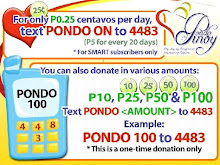
Pondo ng Pinoy is both a Movement and a Community Foundation. As a movement, Pondo ng Pinoy aims to develop a Filipino culture rooted more deeply in love of God and neighbor, especially the poor, through little but repeated acts of compassion, solidarity and sharing, symbolized by the daily giving of 25 centavos. As a Community Foundation, Pondo ng Pinoy is tasked to manage the funds that will be accumulated from the daily contributions of people. These funds and whatever revenues may be gained from investing these funds shall be used solely to support socio-economic development programs or projects to be implemented for the Class D & E population in participating dioceses.
GENERAL POLICY GUIDELINES
1. Processing and approval of proposals shall be based primarily on need and availability of funds. Nonetheless, the Board shall formulate policies to rationalize allocation of funds per Diocese.
2. The Central Office shall process only proposals approved or endorsed by the bishop/s and priest/s of the site where the project shall be implemented. Proposals should be submitted to the Central Office quarterly.
3. Dioceses, the Diocesan Projects Review and Screening Committee of the PnP Desks in particular, and parishes shall be involved in the screening and evaluation of all proposals.
4. The Diocesan PnP Desks are given authority to approve project proposals up to PESOS: THREE HUNDRED THOUSAND (P300,000.00).
5. The Central Office shall respect existing systems, policies (criteria for assistance) and procedures of Dioceses in approving or recommending projects for approval. Nonetheless, these systems, policies and procedures shall be assessed by the Central Office for compatibility with the priorities and standards set by the Foundation. If necessary, Dioceses should be willing to adjust its systems, policies and procedures insofar as projects for PnP funding are concerned.
6. The Central Office shall disburse all financial support to approved proposals through the Diocesan PnP Desk, except for inter-diocesan projects, the funds for which shall be disbursed directly to the proponent; the Dioceses shall be advised on funds directly released to proponents. Release of funds shall be subject to Memoranda of Agreement executed between the proponent and the Central Office and/or the Diocesan PnP Desk
7. Dioceses should be willing to open a separate bank account and establish separate books of accounts for funds to be released by the Central Office.
8. The PnP Desk shall be responsible for reporting to the Central Office on the status of Diocesan-approved projects and how funds were used. The Bishop shall note all proponents’ reports on Diocesan-endorsed projects approved by the Central Projects Review and Screening Committee. Such notation presumes that these reports have been validated by the PnP Desk. All records/ documents pertinent to funds released and projects being assisted should be made available to the Central Office at all times.
9. All funded projects shall be subject to periodic and annual external financial, compliance, management and project-end social audit. The Central Office can withdraw or terminate its assistance at any time should the project proponent, after due process, is proven to have violated the terms and conditions of the assistance and to have failed to act on monitoring and audit findings.
POLICY OF ASSISTANCE
Project Types
The Foundation shall favor development-oriented programs or projects, poor families or communities can tangibly benefit from within three months-one year of project implementation. These programs or projects should:
1. Respond to the problems of poverty and deprivation;
2. Be viable, sustainable and replicable;
3. Have strong community participation;
4. With specific and measurable results;
5. Environment-friendly and gender-sensitive;
6. Build on the experience of the proponent in delivering the intended results.
Initially, programs or projects related to the following will be given priority:
1. Micro-finance - involves individual and group lending for livelihood or enterprise development.
2. Micro-enterprise – involves projects that could generate employment and income for the poor.
3. Housing- provides decent housing to poor families who have acquired security of land tenure but are unable to meet housing construction needs. Should funds be available, bridge-financing for land acquisition or purchase may also be considered.
4. Education- assistance to poor students to acquire formal education or to adults, to increase or enhance their skills for gainful employment or start a business enterprise.
5. Health- programs or projects designed for improved and sustained health condition in poor communities.
Priority Project Sites
Financial assistance shall be limited to programs or projects that will benefit the poor in the fourteen dioceses participating in the Pondo ng Pinoy. These dioceses are as follows:
1. Archdiocese of
2. Diocese of Antipolo
3. Diocese of Cubao
4. Diocese of Daet
5. Diocese of Imus
6. Diocese of Kalookan
7. Diocese of Malolos
8. Diocese of Novaliches
9. Diocese of Parañaque
10. Diocese of
12. Apostolic Vicariate of Puerto Princesa
13. Apostolic Vicariate of Taytay
14. Military Ordinariate
Project Proponent
Project proponents must be non-profit organizations such as social action centers, parish social service and development ministries, church-mandated organizations involved with the poor, parish cooperatives and other non-government and people’s organizations. The project proponent must also possess the following:
1. Capability to manage and implement proposed projects as proven by their track record and experience of at least two years in similar development projects.
2. Sound and functional management system as indicated by the presence of financial records and books of accounts, audited financial reports, set of financial systems, policies and procedures.
3. Clear vision-mission-goals as well as management structures and strong organizational leadership.
4. Credibility with the beneficiary community or organization.
5. Endorsed by the Bishop/parish priest of the site where the project will be implemented. If the project is to be implemented across parishes and/or dioceses, all the Bishops and parish priests of the sites involved should endorse the project.
Project proponents unable to fully meet the above requirements will still be considered for as long as the proponents are credible and can present strong proof of need for the project, are willing to be trained on skills that may be identified by the Central Office and accept technical assistance from organizations to be assigned by the PnP Desk or the Central Office.
Terms of Funding
PnPCF assistance shall be given either as loans or grants. It shall cover only direct project costs. Direct project costs refer to direct materials and labor to be incurred or revolving fund for lending to be used in providing the service or product to the community or sector. Institutional costs, e.g. salaries, staff development, equipment, and other management and overhead expenses, shall form part of the proponent’s counterpart.
A set of policies for assistance shall be formulated by the BOT for start up projects that may need assistance beyond direct project costs. Funds for training and formation needs of projects shall be considered on a case-to-case basis.
Technical assistance needs of supported projects or funding requirements of proposals exceeding the limits to be set by BOT shall be referred by the Central Office to its partner-organizations.
Submission of Proposals
A project proposal must be submitted by a qualified proponent endorsed by the parish priest, if for approval of the PnP Desk, and the Bishop of the community where the project will be implemented if for approval of the Central Office. Furthermore, projects requiring financial assistance of more than P100,000.00 should also be accompanied by the following:
Organization-related documents
1. Notarized Board Resolution or Pastoral Council Resolution, if the proponent-implementor is the Parish or the Diocese, indicating the following:
a. Intent of the organization to secure financial assistance from the Foundation.
b. Commitment to safeguard and properly use the Foundation’s financial assistance and to make available at all times their books of accounts and other documents pertinent to the supported project
c. Assignment of project assets in case of default in payment in the case of loans.
d. Willingness to participate in trainings and formations that may be required by the Central Office and to undertake all other necessary activities to improve projects implementation
e. Names of at least two authorized representatives who will sign all documents pertaining to the project
2. Copy of SEC registration. Copy of PCNC/CDA/DSWD registration/accreditation for proposals involving financial assistance of P500,000 and above
3. Copy of proponent’s Articles of Incorporation and By-Laws
4. Audited Financial Statements of Proponent for the last two years
5. Curriculum Vitae of the officers and management staff of the organization.
Requirement #s 2-4 are not applicable to proposals originating from the Parish or the Diocese.
Project-related documents
1. Location map showing project sites/areas
2. Detailed financial schedules of proposed budget, projected income statements, cash flow (including notes and assumptions). If project will be implemented across Parishes or Dioceses, the proposed budget should be broken down according to project sites.
Project-specific documents
1. Business Plan (if project is an enterprise)
2. Guidelines for Revolving Credit Funds (if applicable)
3. Documents showing proof of approved funding (if the project will use counterpart funds from other donors)
4. Plan, drawings, specifications for infrastructure, machinery and equipment, etc. (if applicable)
5. Training Design (if applicable)
It is important that the proposal discuss the issues of poverty in the community and how these are addressed by the proposed project. Guidelines for packaging a proposal according to the Foundation’s requirements shall be made available to interested proponents. Incomplete proposals shall be returned to the PnP Desk for completion by concerned proponents.
Proposals should be received by the Central Office two weeks before the end of a quarter to facilitate processing and release of funds at the beginning of the following quarter. Proposals received after the cut-off period shall be processed together with proposals received in the next quarter.
Processing of the Proposal
All proposals must undergo a screening and evaluation process.
1. Proposals originating from organizations at the parish level shall be pre-screened by an office or committee duly designated by the parish. All pre-qualified proposals together with all supporting documents shall then be endorsed by the Parish Priest to the PnP Desk for final screening and approval (or disapproval) or for further screening and endorsement to the Central Office in case of projects involving costs beyond P300,000.00 .
2. The PnP Desk shall then notify the Central Office in writing regarding approval of projects supported by a list and profile of projects approved to facilitate release of funds subject to the policy on cut-off for submitting proposals.
3. Each project involving costs beyond P300,000 shall be covered by an endorsement letter from the Bishop stating merits for endorsing the project. The endorsement letter should be sent to the Central Office together with all supporting documents.
4. The Central Projects Review and Screening Committee shall undertake final screening, evaluation and approval of projects involving costs beyond P300,000 but not to exceed P1 million. Projects requiring financial assistance of more than P1million shall be recommended by the Central Projects Review and Screening Committee to the Board of Trustees or the Board Executive Committee for decision.
5. The higher the amount involved, the more stringent the Central Office screening process will be. Additional information may be required by the Central Office to satisfy screening and evaluation requirements. Other professional development practitioners from the Diocese where the proposal originated may be tapped to further validate information contained in the proposal or provide feedback on the proposal.
The duration of the process from the Parish to the Diocesan will depend on circumstances obtaining in the Diocese such as efficiency of existing communication systems. Processing by the Central Office however should not take more than two months.
Release of Financial Assistance
1. All funds for approved projects shall be released to the PnP Account of the Diocese within two weeks upon receipt of notification letter or approval of proposals by the Central Office. The Dioceses shall be notified should there be any delay in the release of funds.
2. Initial release of funds to the PnP Desk shall be subject to a bank certification that an account has been opened to be used exclusively for transactions involving the Central Office’s funds.
3. It is strongly recommended that the PnP Desk release funds following the timeframe of critical activities or projected cash flow as per approved project proposal. The Central Office also requires that release of financial assistance be subject to the following:
a. Signed Memorandum of Agreement between and among all parties concerned.
b. A bank certification that an account has been opened by the proponent to be used exclusively for transactions involving the Foundation’s funds for projects involving P100,000 and above.
c. Separate accounting of funds in accordance with generally accepted accounting principles and standards.
4. Subsequent releases of funds shall be subject to the satisfactory performance of the project and the submission of the following:
a. Report on the use of funds.
b. Narrative report on project accomplishments vis-à-vis targets, problems encountered and what have been done in response to said problems, and plan for the next period, highlighting changes, if any.
Monitoring and Audit
1. All supported projects shall be monitored by the PnP Desk, the schedule of which shall depend on the project cycle and status of the project and the organization at the time of funding. Start up projects and projects to be implemented by proponents with less than two years experience shall be monitored more frequently.
2. All supported projects shall be required to submit quarterly progress and end-of- project narrative and financial reports to the PnP Desk. End-of-project financial reports for projects with financial support amounting to P100,000 and below should be supported by proofs of payments such as O.R.s, check vouchers, etc.
3. All projects, except those with financial support of P100,000 and below, shall be subject to an annual financial, compliance, management audit and project-end social audit to be undertaken by the Board Audit Committee.
Sanctions for Violating Terms and Conditions
The Central Office reserves the right to withdraw or terminate its assistance at any time should the proponent, after due process, is proven to have violated the terms and conditions of the assistance, as well as for failure to act on monitoring and audit findings and recommendations resulting to adverse effects on the project and project beneficiaries. The BOT shall formulate policies on sanctions for default in payment of loans.